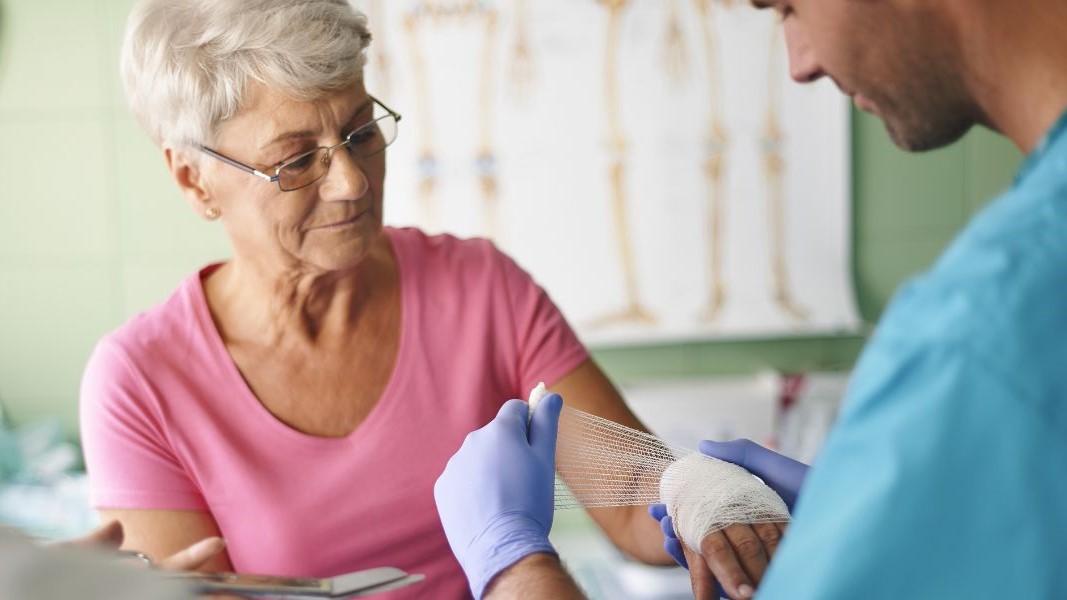
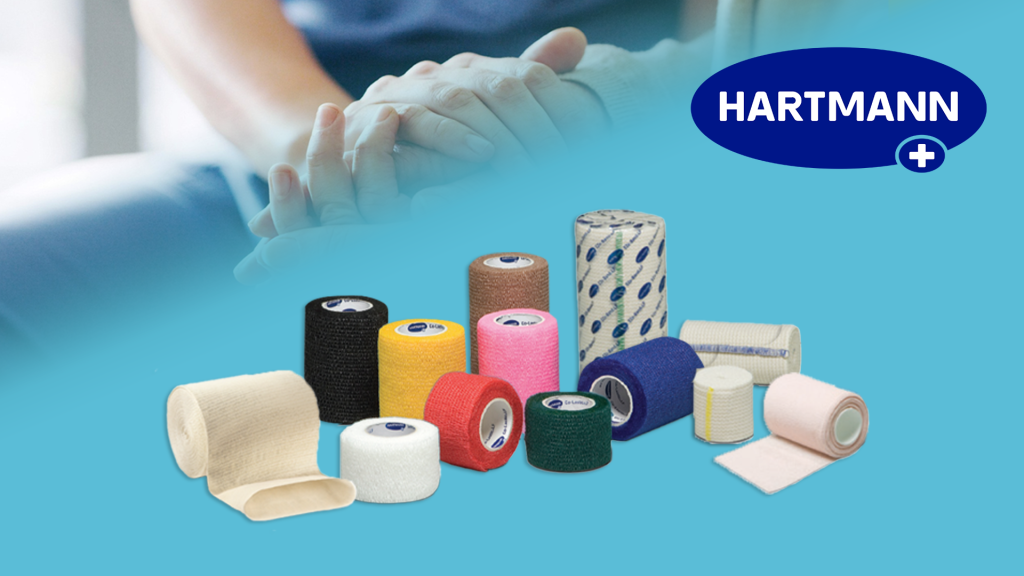
About 300,000 people in the U.S. are hospitalized due to acute wounds each year—just a fraction of the 11 million Americans estimated to experience acute wounds annually.
Fortunately, there are increasingly specific, innovative products on the market to help wounds heal.
How Hartmann Dressings Heal Wounds: Pt. 2
In Part 1, we explored how different Hartmann gauze roll products serve three distinct wound care functions:
- Protection: covering the wound to shield it from the environment and infectious pathogens.
- Stabilization: holding the wound closed and keeping an injury in the right place.
- Treatment: killing germs to prevent infection, relieving pain, and soothing symptoms like inflammation.
Part 1 also explored the features, use cases, and contraindications of different gauze types.
The second half of our guide offers similar insights into two other significant categories of Hartmann wound care supplies.
Learn everything you need to know to use elastic bandages and cohesives effectively. Compare their features, benefits, and drawbacks to choose the right Hartmann dressing for your needs.
Cohesives & Self-Closure Wraps
Self-adherent cohesive wraps and conforming paste bandages create an optimal environment for wound healing, while reducing the risk of re-injury.
Self-adherent cohesive wraps are fabric, elastic bandages that stick to (adhere to) their own surfaces, but not to skin or hair. They are not coated with any adhesive substance.
Knitted and woven fabric elastic cohesives are covered in other sections in this guide.
Conforming paste cohesives are bandages made of a soothing, non-hardening paste that conforms to the area it’s applied to.
Cohesives offer a fairly wide range of compression pressures.
Cohesive Wrap Paste Bandage
Hartmann’s Econo-Paste Plus Calamine Unna-Boot Conforming Paste Bandage is a conforming paste cohesive infused with soothing Calamine. The wrap provides firm, moderate compression (20-30mmHg).
It’s designed to conform closely to any body shape, promote a moist wound healing environment, and reduce irritation. It’s most effective when used to calm inflammation and manage ulcers.
How To Wrap Wounds With Conforming Paste Cohesive
To learn how to bandage with paste cohesive wraps, read this guide produced by the nonprofit National Eczema Society:
A Practical Guide to Their Use in
While some of the guide is eczema-specific, the instructions apply to almost all applications of “wet wrap” cohesives.
Flex-Band: Small Adhesive Strip Elastic Bandages
Hartmann’s Flexband® bandages are categorized as “adhesive strips,” a general term for the simple, commonplace bandages found in every first aid kit.
Bandages in this category are small, flexible, elastic, flat strips or patches. Each incorporates a non-stick wound pad and either an adhesive-coated border or tabs.
Adhesive strip bandages are designed to cover and protect minor cuts, scrapes, or blisters. They can also hold small cuts closed for stabilization and hold applied ointments in place.
Flex-Bands are particularly easy to use, with simple peel-off backing and non-irritating adhesive. Their materials and elasticity effectively protect minor wounds from infection, and they improve the wound’s environment to promote healing without scarring.
Unlike most other adhesive strip elastic bandages, Flexbands® are ideal for those with sensitive skin. Each aspect of the design reduces irritation:
- The backing is an allergy-friendly 30% polyamide 70% viscose fabric blend.
- The 100% polyethylene wound contact layer is non-adhering and irritant-free.
- It sits easily between the wound and an absorbent viscose / polyethylene pad.
- The adhesive itself is a hypoallergenic, synthetic rubber-based coating.
- It’s latex-free, and it doesn’t leave behind any adhesive residue upon removal.
They also seal more securely than many similar bandages, protecting the minor wound from water and environmental debris.
Notably, their small size and limited absorbency make Flex-Bands unsuited for deeper cuts, full-thickness burns, and any wound with moderate-to-high exudate.
Hartmann offers Flexband® bandages in ten different shapes and sizes for the most common minor injury types. See if these options are right for you:
Flex-Band Oval-Shaped Bandages
How To Use Flex-Band Elastic Adhesive Bandages
Before opening the bandage, rinse the cut or scrape with clean water. Optionally, use soap to clean the skin around the cut. Apply an over-the-counter antibiotic salve, like Neomycin or bacitracin.
Likewise, before bandaging a very small, 1st-2nd degree burn that blisters, apply a cool, wet cloth. Blot it with a dry, clean pad. Apply a soothing aloe or topical, diluted lidocaine gel to relieve pain.
Once the minor wound is clean and ointment has been applied, cover it with the bandage.
When peeling away the paper from a Flexband®, be sure to only touch the adhesive edges of the bandage. As you place the Flex-Band, make sure the wound pad only touches the wound, not your fingers or skin.
The adhesive parts of the Flex-Band secure it to the skin on either side of the wound, holding the polyethylene pad in place to cover the wound itself.
Large Elastic Bandages For Stability & Compression
Unlike Flexband® adhesive strip bandages, large elastic bandages are adhesive-free. Moreover, they aren’t used as flat patches or strips.
Instead, these elastic bandages are stretchy fabric rolls with closures or self-cling properties. They’re designed to wrap entirely around the injury site, applying localized pressure.
Large elastic bandages are used to stabilize injured bones, joints, ligaments, and muscles. They can also compress, reducing swelling in sprains and closed, moderate-to-severe wounds.
Hartmann offers 5 types of bandages in this category to serve diverse functions:
- Elastic conforming gauze bandages
- Conforming gauze rolls, like Peha-Haft bandages, were covered in Part 1.
- Self-closure knit fabric bandages
- Used for general dressing securement & joint / bone injury support
- Tubular, seamless elastic bandages
- Tubular stretch wraps offer consistent, low-pressure compression.
- Stand-alone woven elastic bandage rolls
- Used for high-grade stabilization & compression
- Compression bandage systems
Each type has distinct features for specific uses.
Self-Closing Knitted Fabric Bandages
Knitted elastic bandages are relatively soft. They’re more flexible and adapt to the body’s movements more readily than woven elastic bandages. However, the degree of support a knit bandage offers is lower than that of its woven counterpart. There’s a tradeoff.
Knitted fabric elastic bandages can compress injuries, though not at the highest levels of pressure. They’re typically used to support joint or ligament injuries.
Shur-Band LF Self-Closure Bandage
Hartmann’s Shur-Band LF Self-Closure Bandage is a “latex-free self-closure bandage that secures and supports without clips, pins, or tape.”
It’s primarily used to secure dressings, cushion healing tissue, and support bone and ligament injuries. It’s also safe to use the Shur-Band as a secondary dressing to manage edema.
Eze-Band Basic
The EZe-Band Basic – Non-Sterile is an “orthopedic grade knitted bandage,” designed to simplify wrapping.
Its “unique knitted construction provides superior absorbency and breathability,” making it an effective bandage to manage post-operative swelling.
Tubular Elastic Bandages
Coverflex® Grip Tubular Bandage
The Hartmann Coverflex® Grip Tubular Bandage is a cotton-blend elastic tubular bandage.
Its tube shape enables “360 degrees of uniform, consistent support,” simplifying the low-level compression process by eliminating the need to wrap. Just use the sizing guide to choose the right Coverflex® tube for you.
When you use the right fit, tubular elastic bandages make managing lymphedema, edema, swelling, and joint support less stressful. The Coverflex® further reduces stress, as its seamless and latex-free design minimizes irritation.
Woven Cotton Elastic Bandages (Stabilizing)
Woven cotton elastic bandages are firmer and more durable than knit elastic bandages. They offer higher resistance, stronger support, and, typically, less flexibility than their knit counterparts.
High-resistance bandages are designed to maximally support and stabilize joints or limbs, minimizing swelling during activity without severely restricting the patient’s movement overall.
Woven cotton elastic bandages are best used to treat edema, lymphedema, and venous leg ulcers. They’re not always the right choice for joint sprains or sports injuries.
Deluxe LF Elastic Bandage
Deluxe LF Elastic Bandage is a long-stretch, medium compression, high-resistance elastic bandage. It offers greater flexibility than a short-stretch bandage, yet consistent compression. It’s designed for use in orthopedic care and post-surgical compression.
Lopress Elastic Compression Bandage
The Lopress Elastic Compression Bandage is a high-resistance, “short stretch” compression bandage. It’s a maximum resistance compression bandage optimized for durability and comfort. It can withstand several wash cycles and ointment without degrading.
Short stretch cotton elastic bandages exert high “working pressure” and low “resting pressure.” They react to prevent fluid retention or swelling throughout the day, then exert a lower, more comfortable pressure during restful, low-swelling-risk activities.
How To Stabilize Injuries With Elastic Bandages
Using an elastic bandage to stabilize injuries is an important first aid technique.
Fortunately, the nonprofit Wounds UK has published “Back to Basics: Correct Bandaging.” Wounds UK’s detailed elastic bandaging guide is available for free on their website.
Compression Bandage Systems
Compression bandage systems layer different fabrics and wraps to benefit from each one’s strengths. They enable more precise control over factors like pressure, cushion, friction, and stretch, which can enhance the bandages’ therapeutic effects.
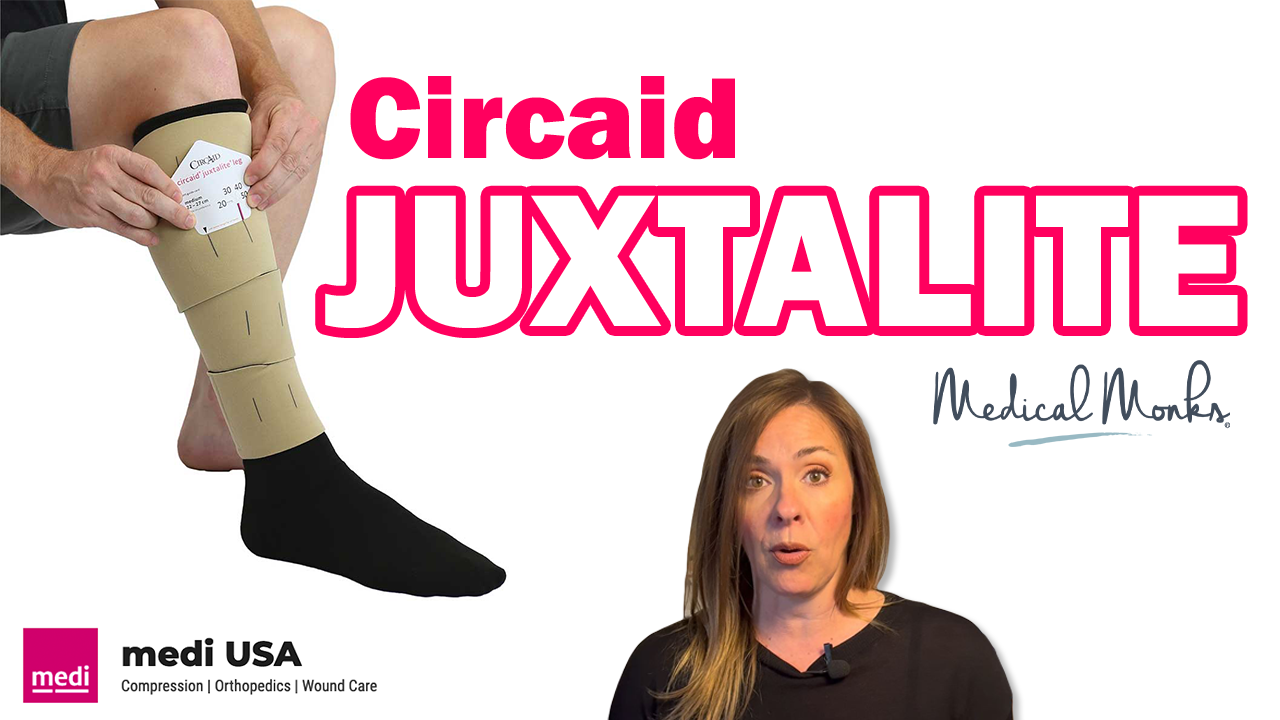
TwoPress, ThreePress & FourPress Compression System
Hartmann offers a compression bandage system that empowers people to customize the number of layers.
TwoPress 2 Multi-Layer Compression System
TwoPress 2 Lite Multi-Layer Compression System
ThreePress Multi-Layer Compression Bandaging System
FourPress Multi-Layer Compression Bandaging System
How To Compress Wounds With Elastic Bandage Layers
Each of the Hartmann multi-layer compression bandage systems includes a user manual. For example, the TwoStep Application Guide offers illustrated, step-by-step instructions.
Risk & Contraindications With Elastic Bandage Rolls
Elastic bandages in this category shouldn’t be used directly on open wounds, infected wounds, or complex wounds.
Moreover, bandages that even mildly compress are risky to use if the injured person has a medical condition that affects circulation. Examples include Peripheral Arterial Occlusive Disease (PAOD), cachexia, or pre-existing neuropathy.
People with these conditions should take extreme precautions when using a compression bandage. They’re usually better served by alternate, non-compressive treatments whenever possible.
Shop Hartmann Wound Care Supplies At Medical Monks
For premium quality elastic bandages, wraps, and cohesives, shop Medical Monks’ online Hartmann Store today.
To learn more about Hartmann gauze dressings and related wound care products, read Pt. 1

The MEDICAL MONKS STAFF brings to the table decades of combined knowledge and experience in the medical products industry.
Edited for content by JORDAN GAYSO.